
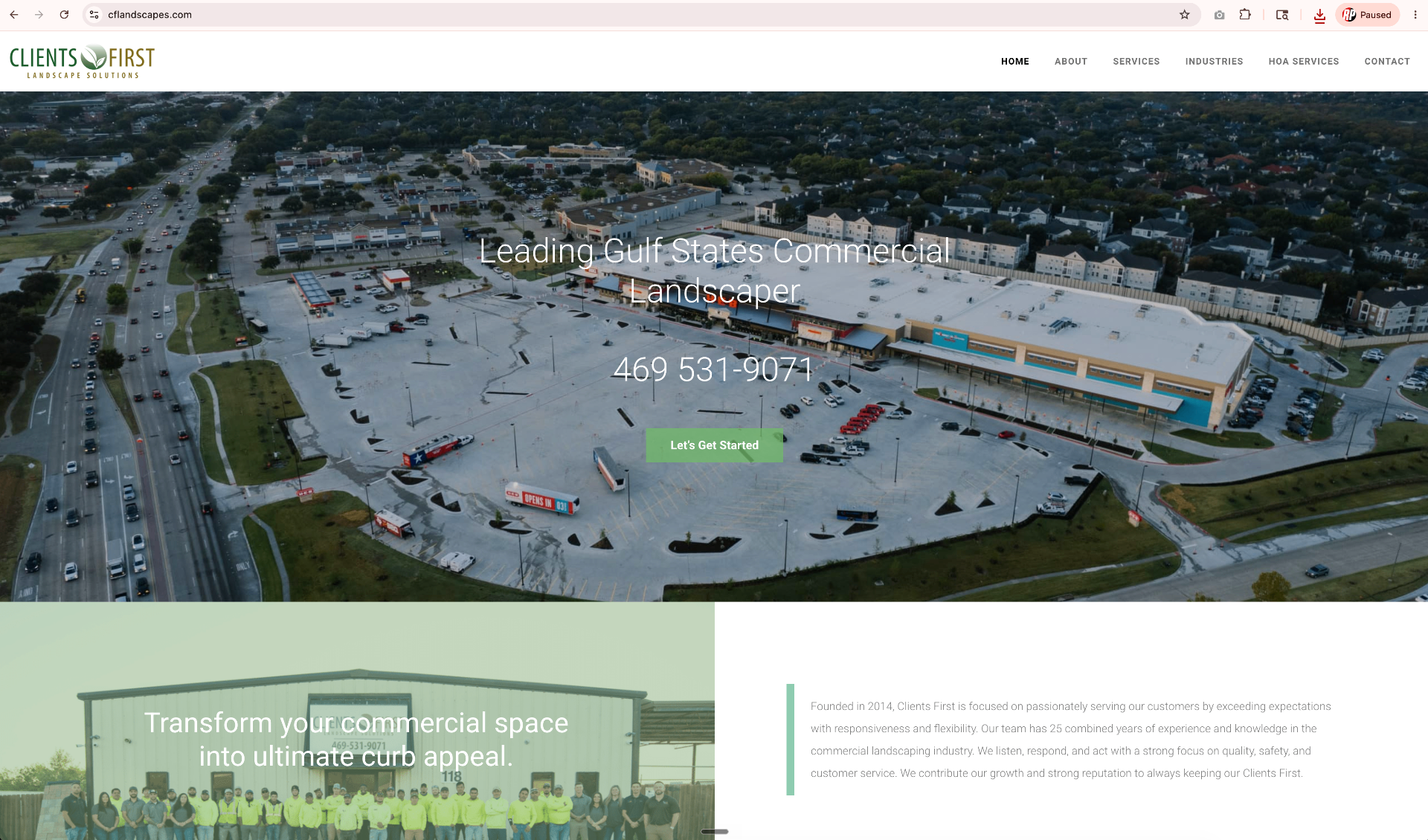
A full-spectrum partnership behind Clients First Landscape Solutions.
Premium work, invisible online, and a category dominated by template chains.
Clients First was producing some of the most beautiful outdoor environments in Texas, but the digital footprint didn't match the craft. Search was owned by national brands and franchise sites with deep budgets and shallow portfolios.
No organic visibility for the high-intent luxury landscape and pool terms.
A site that didn't reflect the design caliber of the actual projects.
Paid campaigns running, but without the tracking to prove they worked.
Lead quality varied wildly: too many tire-kickers, too few qualified estates.
A category dominated by template chains with bigger budgets and weaker brands.
Build the engine once. Then refine it every quarter for ten years.
SEO foundation engineered to compound
We rebuilt the site architecture and content from the ground up for the way luxury homeowners actually search.
Paid media tuned for qualified estates
Every paid dollar was instrumented and tuned to a single question: did this produce a high-value project, not just a form fill.
A site that finally matched the craft
We redesigned the experience to feel like the actual properties: confident, restrained, photography-first.
A ten-year partnership, not a project
Most agencies churn clients on a 12–18 month cycle. We've been here for a decade because the work compounds when you stay.
monthly organic visits: built from a baseline of effectively zero, sustained at 300%+ paid ROI, compounding across a full decade of partnership.
What a decade of compounding looks like in the numbers.
This is what happens when an agency actually stays. Most landscape companies churn through three or four marketing partners in a decade. Clients First chose to compound, and so did we. The SEO investment from year two is still paying back in year ten. The paid programs from year five became the model for the rest of the category. The result is a brand that no template-chain competitor can catch, because they don't have the ten years of compounding behind them.